The History of Cinema: A Journey Through Time
Cinema, often referred to as the seventh art, has been a significant part of cultural and social life for over a century. From its humble beginnings as a scientific experiment to its current status as one of the most influential forms of entertainment, cinema has undergone profound changes. It has shaped not only the world of entertainment but also the fabric of society, politics, and even technology. This blog will delve deep into the history of cinema, exploring its origins, key developments, major milestones, and the technological and artistic revolutions that have defined its evolution.
Early Beginnings: The Birth of Cinema
The Pre-Cinema Era: The Seeds of Motion Pictures
Before the invention of cinema, there were several precursors that paved the way for moving images. These included devices like the magic lantern (17th century), which projected images onto a screen, and the zoetrope (1834), a spinning drum that created the illusion of movement. However, these were not true motion pictures but rather static images that, when viewed in rapid succession, gave the illusion of motion.
The first step toward modern cinema came in the form of experiments by scientists and inventors in the 19th century, such as Eadweard Muybridge and Étienne-Jules Marey. In 1878, Muybridge famously used a series of cameras to photograph a galloping horse, capturing each phase of the horse’s movement. This experiment helped prove that all four of a horse’s hooves leave the ground at the same time when it gallops. Although Muybridge’s work was groundbreaking, it was still far from what we would now call cinema.
Meanwhile, in Europe, Louis Le Prince made short films using the first motion picture camera in the late 1880s. His film "Roundhay Garden Scene" (1888) is considered one of the earliest surviving motion picture recordings. Although many of Le Prince’s works were lost, his contributions were essential in the early development of cinematic technology.
The Lumière Brothers: The Birth of Modern Cinema
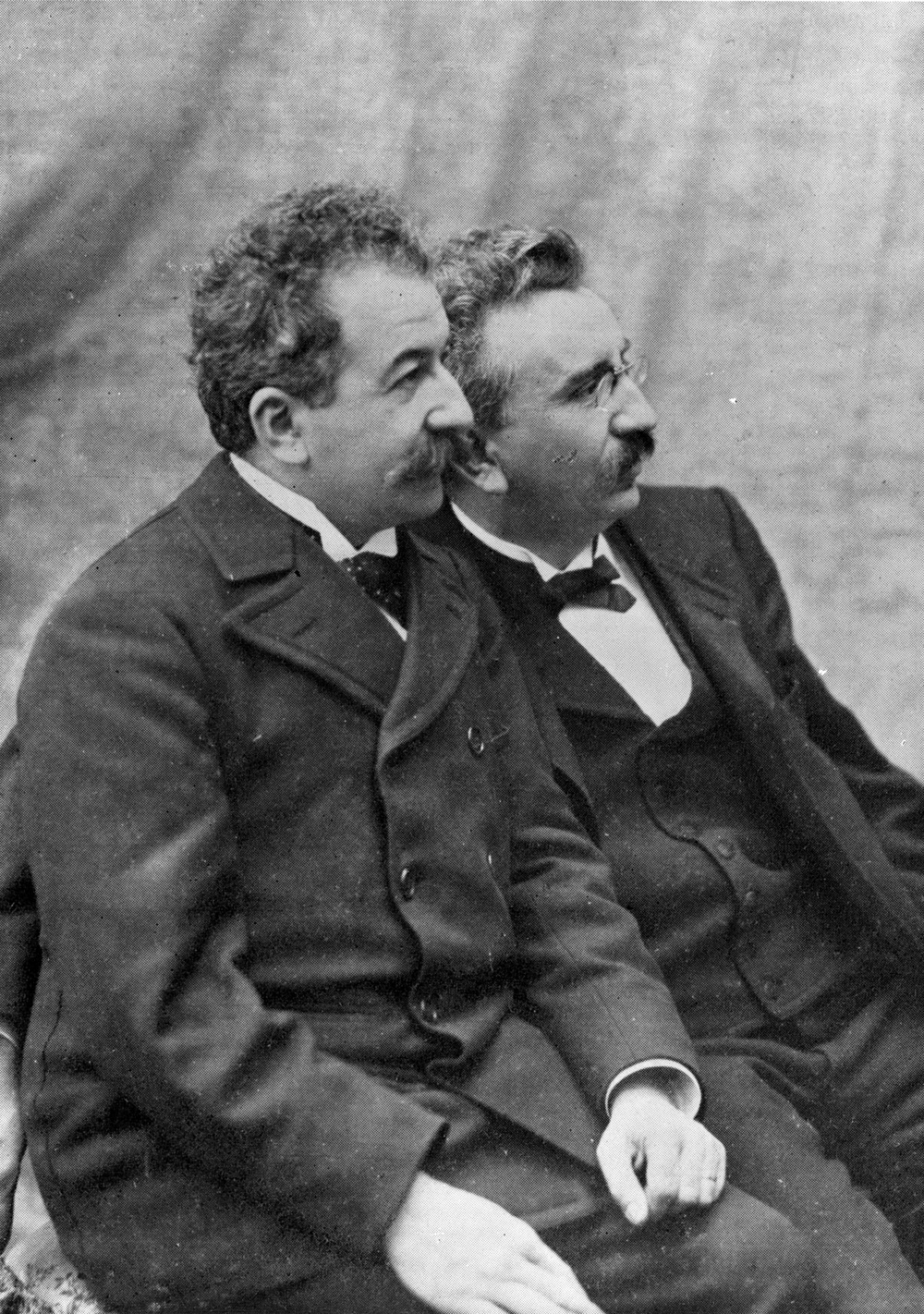
The first true motion picture camera was created by the Lumière brothers, Auguste and Louis Lumière, in 1895. They are often credited with inventing the cinema as we know it today. In December 1895, the Lumière brothers held the first public screening of a moving picture at the Grand Café in Paris, featuring short films such as "La Sortie de l'Usine Lumière à Lyon" (Workers Leaving the Lumière Factory) and "L'Arrivée d'un Train à la Ciotat" (Arrival of a Train at La Ciotat Station). These early films were filmed in one continuous shot and were remarkably simple in their content, typically showing everyday life.
The Lumière brothers' invention of the Cinématographe revolutionized filmmaking. It was a portable camera that could record, develop, and project films. Their innovation was instrumental in the establishment of cinema as a commercial entertainment form, as it allowed for mass distribution and viewing.
Thomas Edison and the Kinetoscope
While the Lumières were establishing cinema in France, Thomas Edison was simultaneously working on his own motion picture technology in the United States. Edison’s Kinetoscope was a machine for viewing moving pictures. It became popular in the 1890s, even though it didn’t project images on a screen for public viewing. Instead, viewers would peer through a lens at a strip of moving film. The Kinetoscope eventually led to the invention of projection systems and cinema theaters.
The Silent Film Era: The Rise of Narrative Cinema
The Early 1900s: A Global Expansion
The early years of cinema saw the development of new film techniques and genres. As the medium grew in popularity, the first movie studios were established in the United States and Europe. By 1903, Edwin S. Porter’s film "The Great Train Robbery" introduced narrative filmmaking. This movie is often cited as the first true Western film and one of the first to employ editing techniques like parallel action and cross-cutting.
During the next decade, directors began experimenting with cinematic storytelling. D.W. Griffith, one of the most influential filmmakers in early cinema, perfected editing techniques and introduced the use of close-ups and cross-cutting in his films. His 1915 epic "The Birth of a Nation" (despite its controversial and racist content) is regarded as a groundbreaking work for its innovative use of narrative techniques and visual storytelling.
The Rise of Hollywood: From Silent Films to Star Power
While European cinema was flourishing, Hollywood was beginning to assert its dominance in the global film industry. The 1910s and 1920s saw the creation of Hollywood as the epicenter of the film world. Studios like Paramount, Universal, and Warner Bros. emerged, and the "studio system" began to take shape. This era also saw the rise of movie stars, such as Charlie Chaplin, Mary Pickford, and Douglas Fairbanks, who became iconic figures of the silent film era.
The silent film era also saw the introduction of slapstick comedy, pioneered by Charlie Chaplin and Buster Keaton. Chaplin’s character, "The Tramp," became a symbol of the era, with films like "City Lights" (1931) becoming timeless classics.
The Advent of Sound: The End of the Silent Era
The introduction of synchronized sound in the late 1920s was one of the most significant milestones in film history. In 1927, Warner Bros. released "The Jazz Singer", the first major sound film, which combined synchronized dialogue with music. The success of "The Jazz Singer" marked the end of the silent film era, as audiences and filmmakers quickly embraced the new technology.
Sound revolutionized filmmaking in numerous ways. Directors and screenwriters had to adjust their storytelling techniques to accommodate dialogue, and filmmakers began experimenting with sound effects, music scores, and even the rhythm of speech. The 1930s saw the emergence of musical films, with stars like Fred Astaire and Ginger Rogers dazzling audiences with their songs and dances.

The Golden Age of Hollywood and the Rise of Cinema as an Art Form
The 1930s-1950s: The Hollywood Studio System
The 1930s to 1950s is often referred to as the Golden Age of Hollywood. During this period, the studio system reached its peak. Studios controlled every aspect of production, from casting and directing to distribution. Hollywood became a factory of film, pumping out hundreds of films each year. Genres such as film noir, screwball comedy, and epic historical dramas flourished during this time.
Orson Welles' landmark film "Citizen Kane" (1941) is considered one of the greatest films of all time. Welles’ innovative use of deep focus cinematography, non-linear storytelling, and groundbreaking sound design influenced countless filmmakers.
Meanwhile, the rise of color films—pioneered by Technicolor—changed the visual landscape of cinema. Movies like "The Wizard of Oz" (1939) and Gone with the Wind (1939) showed the potential of color in storytelling and established it as a permanent feature in film.
The Post-War Era: Independent Films and International Cinema
Following World War II, cinema began to experience a series of changes. The dominance of Hollywood began to wane as audiences sought more diverse narratives. European cinema grew in influence, with filmmakers like Ingmar Bergman and Jean-Luc Godard challenging traditional filmmaking norms.
The French New Wave (1950s-1960s) was a major turning point. Directors like Godard, François Truffaut, and Agnès Varda revolutionized cinema by breaking the rules of continuity editing, embracing handheld cameras, and telling stories about contemporary life. This movement inspired filmmakers worldwide to experiment with form and content.
The Modern Era: Technological Innovation and Global Cinema
The 1960s-Present: The Rise of Blockbusters and Digital Cinema
The 1970s saw the rise of the blockbuster with films like "Jaws" (1975) and "Star Wars" (1977), directed by Steven Spielberg and George Lucas, respectively. These films not only achieved massive commercial success but also redefined the scope of cinema with spectacular special effects and immersive sound design.
The 1990s and 2000s witnessed the arrival of computer-generated imagery (CGI), with films like "Jurassic Park" (1993) and "The Matrix" (1999) pushing the boundaries of visual effects. These technological advances allowed filmmakers to create more fantastical worlds, revolutionizing action, fantasy, and science fiction genres.
The digital revolution, along with the advent of streaming services like Netflix and Amazon Prime, has further transformed the cinematic landscape. Today, films are produced, distributed, and consumed in entirely new ways, and the line between cinema and television is increasingly blurred.
Conclusion: The Future of Cinema
Cinema’s history is a testament to human creativity, technological advancement, and cultural transformation. From the humble experiments of the late 19th century to the digital age of today, cinema has constantly evolved to reflect and shape the world around it. As technology continues to progress, it’s clear that cinema will remain an essential art form—one that reflects the values, dreams, and aspirations of society while constantly pushing the boundaries of what’s possible.
As we look forward to the future of cinema, one thing is certain: the journey of film is far from over, and its story will continue to unfold in exciting and unexpected ways.

Comments
Post a Comment